How to Choose Abun Alternatives Autoblogging Software: Buyer's Guide
Choosing autoblogging software means betting your publishing schedule on one tool. Many platforms cap output, burn credits on rewrites, or bury WordPress publishing behind extra steps. Pick wrong and your content pipeline stalls within weeks.
This guide breaks down Autoblogging.ai as an Abun alternative: who it serves, its 10+ AI modes, semantic SEO and SERP analysis, credit-based pricing, rollover terms, and integrations. By the end, you will know whether it fits your blog, agency, or affiliate workflow.
What Is Autoblogging.ai? A Buyer's Guide to the Smarter Abun Alternative
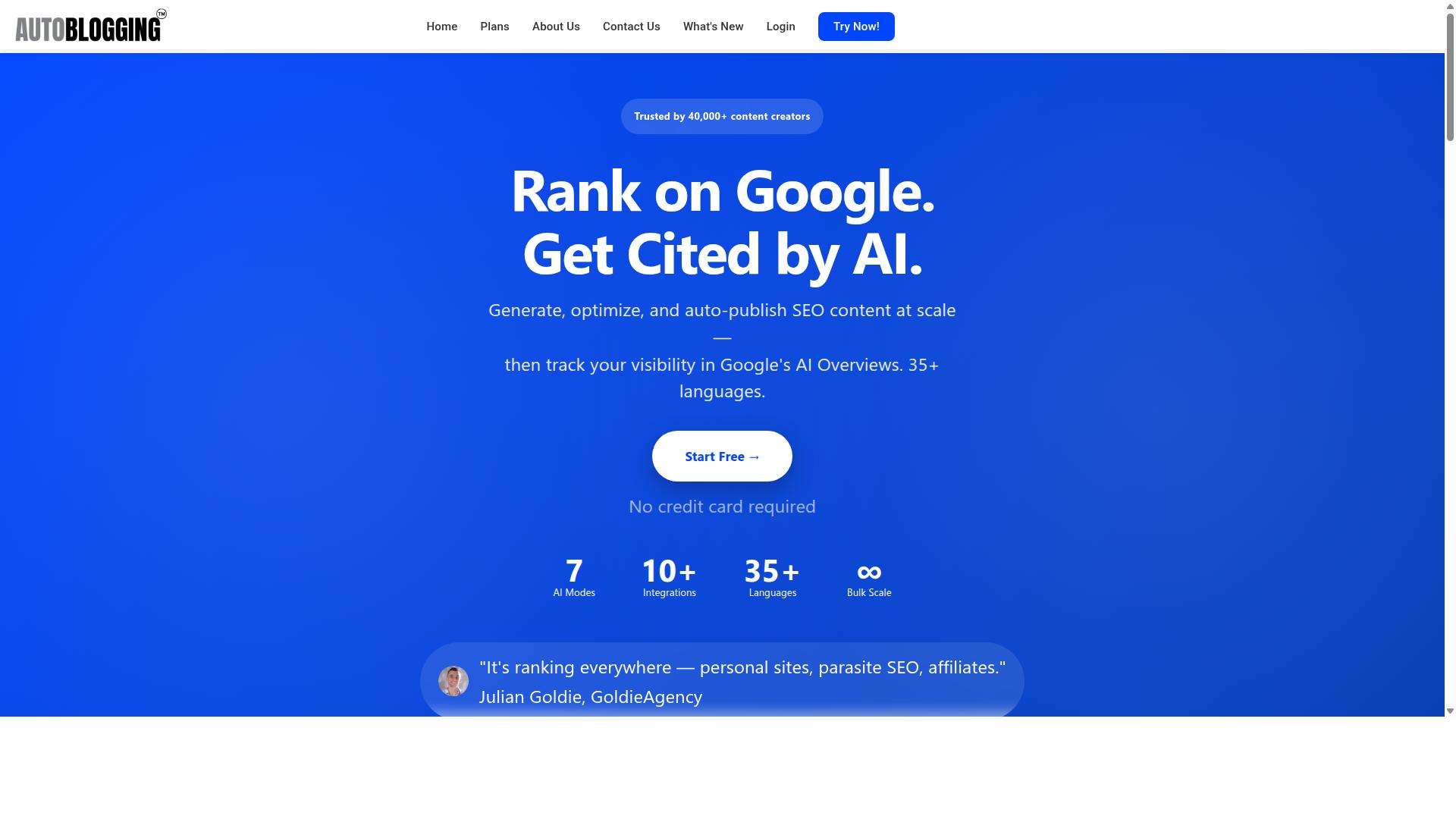
Autoblogging.ai is an AI-powered content automation platform that generates and publishes articles, positioning itself as a smarter alternative to Abun for bloggers and agencies seeking efficiency. It is a SaaS product from Digimetriq.com, built on a clear mission: help bloggers, website owners and agencies save time and improve their online presence through cutting-edge technology.
At its core, the platform handles two jobs that traditionally eat up hours of manual work. It generates content, then it auto-publishes that content, so a site keeps producing fresh articles without someone sitting at a desk pushing every post live by hand.
That combination matters because the older generation of autoblogging tools, Abun included, tends to lean on manual workflows and higher running costs. Users often stitch together scrapers, spinners, and schedulers themselves, then babysit the pipeline. The result is a fragile setup that works until it doesn't.
Autoblogging.ai approaches the problem from the other direction. Digimetriq's stated aim is to cut down content costs and enable human counterparts in standard operating procedures with the first draft, with a longer-term goal of replacing human counterparts entirely. Whether you run one site or fifty, that framing shapes what the tool is for.
Availability is global. Because it is a cloud-based SaaS platform rather than a self-hosted script, there is no server to configure, no plugin conflicts to chase, and no local installation to maintain. You access it online, which also means updates and improvements reach every user at once.
This guide exists because "Abun alternative" searches usually lead people into a maze of half-answers. Some tools are article spinners dressed up as AI content generators. Others are WordPress autoblogger plugins that only handle publishing. Autoblogging.ai sits in a different category: a full content automation platform that covers generation and automated publishing together.
If you are weighing options, the useful questions are practical ones. Who is the tool actually built for? How does subscription pricing compare with a lifetime license? Does the output hold up on content quality, readability, and uniqueness? How well does it handle SEO optimization, keyword targeting, and semantic relevance? The sections ahead break those questions down so you can judge Autoblogging.ai on its merits rather than on marketing copy.
Who Autoblogging.ai Serves: Bloggers, Agencies, SEOs and Affiliates
Autoblogging.ai is built for bloggers, website owners, SEO professionals, marketing agencies, content creators, and affiliate marketers who need to scale content production without sacrificing quality. Those groups have different workflows, but they share one bottleneck: producing enough articles to keep search engines and audiences engaged.
Bloggers and website owners typically run personal sites, local sites, or small portfolios. A solo blogger publishing 50 articles a month would normally face weeks of writing, editing, and formatting. With an AI content generator handling the first draft and automated publishing handling the rest, that same output becomes a scheduling decision rather than a daily grind.
Agencies carry a heavier load. They manage client websites, which means multiple brands, multiple niches, and multiple publishing calendars running at once. Bulk generation and drip feed scheduling matter here, because an agency's value comes from consistent delivery across every account, not from one hero article.
SEO professionals often work on parasite SEO and portfolio sites, where the goal is coverage. They need content aimed at long-tail keywords, LSI keywords, and specific semantic clusters, produced at a volume that manual writing cannot match. Scheduling and posting frequency controls let them pace that output deliberately.
Affiliate marketers build niche sites where the economics are simple: more relevant content means more entry points for organic traffic. Long-tail keyword targeting is the lever, and automated publishing is what makes a hundred-page niche site realistic for one person.
Content creators round out the list. They use the platform to turn ideas into publishable drafts, then apply their own voice and edits before anything goes live. The tool supplies the first draft, and the human supplies the judgment.
What ties these audiences together is the underlying promise from Digimetriq: cut content costs, save time, and improve online presence. Autoblogging.ai is not positioned as a replacement for strategy or editorial standards. It is positioned as the engine that removes the repetitive production work so the people behind the sites can focus on growth.
For anyone comparing it against Abun or other autoblogging software, the audience fit is the first filter. If you publish at volume across one or many sites, and you want generation and publishing handled in one place, you are squarely in the group this platform was designed for.
Why Autoblogging.ai Is the Trusted Abun Alternative
With over 40,000 content creators, a 4.9 average rating, and more than 1 million articles generated, Autoblogging.ai has earned trust as a dependable Abun alternative.
Many users start their search for Abun alternatives after hitting limits they did not expect. Common frustrations include a narrow set of generation modes, limited language coverage, and long gaps between feature releases. Autoblogging.ai addresses each of those pain points directly.
The platform ships 10+ AI modes, supports 35+ languages, and connects with 35+ integrations. New features are released weekly, so the tool keeps pace with changes in search and content workflows rather than falling behind.
Reliability matters just as much as raw capability. Autoblogging.ai pairs its automation engine with a human proofreader on every plan, plus 24/7 support. For buyers weighing a switch, that combination of scale, ongoing development, and oversight is what turns a promising tool into a safe long-term choice.
40,000+ Users, 1M+ Articles and a 4.9 Average Rating
Autoblogging.ai's 40,000+ user base and 1 million articles generated underscore its reliability, backed by a 4.9 average rating from satisfied customers.
A community of that size matters for two reasons. First, it signals platform stability: a tool used by tens of thousands of creators has proven it can handle volume without collapsing. Second, it means more shared knowledge, from workflow tips to community discussions, for anyone migrating from Abun.
The 1 million plus articles figure speaks to scalability. It shows the system performs across a wide range of niches, languages, and publishing schedules, not just a single narrow use case.
The 4.9 average rating reflects something harder to fake: consistent quality and responsive support over time. A high score sustained across a large user base suggests buyers are getting what they expect.
Industry voices reinforce that picture. Julian Goldie of GoldieAgency, whose YouTube channel has 250k+ subscribers, and James Dooley of FatRank and PromoSEO have both lent their names as testimonials. Additional endorsements come from Bart Magera (MojoLinks), Kyle Duncan, Dimitar Georgiev (CEO, IDEAMAX.EU), Cagri Sarigoz, and Jacky Chou (Indexsy).
For a buyer comparing Abun alternatives, this mix of adoption, output volume, satisfaction scores, and named expert backing makes Autoblogging.ai the lower-risk option. The track record is already there.
Key Features That Make Autoblogging.ai Stand Out
Autoblogging.ai distinguishes itself with over 10 AI modes, semantic SEO capabilities, and seamless WordPress integration, offering a comprehensive content automation suite. Instead of stitching together several tools, users get content creation, optimization, and publishing under one roof.
The platform's strength lies in how its pieces connect. An article can move from an AI content generator to an optimization pass, then straight into a live post. That flow removes the manual handoffs that slow down most autoblogging workflows.
Beyond generation, Autoblogging.ai includes a Site Optimizer, Snippet Optimizer, Topical Maps, Fan Out Queries, AI Infographics, Outreach Prospects, an AI Proofreader, a Human Proofreader, and a Content Repurposer. These tools support the full lifecycle of a post, not just the first draft.
Publishing reaches well past a single blog. The platform connects to WordPress, Web 2.0 sites like Medium, Dev.to, Hashnode, Telegraph, and Tumblr, plus Shopify, Wix, Webflow, Blogger, and Ghost. API, Zapier, and n8n access add further flexibility for custom setups.
For buyers comparing Abun alternatives, this breadth matters. A tool that handles generation, SEO, and distribution in one place reduces the number of subscriptions and moving parts in a content operation. The subsections below break down the two feature groups that carry most of that weight.
10+ AI Modes: Quick, Godlike, Bulk, News and Amazon Reviews
Autoblogging.ai offers over 10 AI modes, including Quick Mode for free single articles, Godlike Mode for in-depth SERP analysis, Bulk Generation for up to 500 articles at once, and specialized modes for news and Amazon reviews. Each mode targets a different content strategy rather than forcing one workflow on every user.
Quick Mode handles fast, free single articles, including a wizard option for guided creation. It suits bloggers who want to test the platform or produce one-off pieces without committing to a larger batch.
Godlike Mode draws on SERP competitor analysis, LSI keywords, and knowledge graph extraction. This mode fits competitive niches where topical depth decides who wins the click.
Bulk Generation scales output, producing up to 500 articles through a CSV upload. It is built for site owners managing multiple properties or building out large content libraries quickly.
Two niche modes round out the lineup:
- News Mode connects with Google News integration for timely, current-event content.
- Amazon Reviews Mode supports affiliate-focused articles around product reviews.
Together these modes cover rapid drafts, competitive research, mass production, and affiliate publishing. That range lets a single autoblogging software subscription serve several content strategies at once, which is a key point of comparison in any buyer's guide.
Semantic SEO, SERP Analysis and One-Click WordPress Publishing
Autoblogging.ai enhances content quality with semantic SEO, SERP competitor analysis, and one-click WordPress publishing, ensuring articles rank well and go live effortlessly. These three capabilities form the bridge between a finished draft and a published, search-ready post.
Semantic SEO centers on LSI keywords and knowledge graph extraction. A 21-point Semantic SEO Analysis audit gives users a structured way to assess topical relevance before publishing.
SERP analysis adds a competitive layer. By examining what already ranks for a target query, the platform helps users spot content gaps and coverage that top results share. This supports smarter keyword targeting and long-tail keyword planning.
Publishing is where the workflow pays off. The WordPress integration supports unlimited sites, a one-click setup, a plugin, and scheduled auto-posting. Users can control scheduling, drip feed, and posting frequency, so content rolls out at a steady pace instead of landing all at once.
Flexibility extends beyond WordPress through API, Zapier, and n8n connections, plus the multi-platform publishing options noted earlier. For anyone weighing Abun alternatives, the combination of semantic optimization, competitor insight, and automated publishing is what turns a content generator into a complete content automation system.
Pricing and Plans: What You Get for Your Credits
Autoblogging.ai offers tiered monthly and annual subscription plans, with credits that roll over, ensuring flexibility for users at any scale. Six tiers span from Starter to Enterprise, so a solo blogger testing automated publishing and an agency running hundreds of sites can both find a fit.
The credit model keeps costs predictable. You buy a plan, spend credits as you generate content, and unused credits carry over instead of expiring at the end of the billing cycle. That matters for anyone whose posting schedule fluctuates, since a quiet month does not mean wasted spend.
Every plan also includes access to a human proofreader, a value-add that separates Autoblogging.ai from tools that stop at raw AI output. New accounts get 10 free credits per month with no credit card required, so you can evaluate content quality before committing to a paid tier.
Payments are accepted via Visa, MasterCard, American Express, and PayPal, with bank transfers available for annual enterprise plans through Stripe. You can cancel anytime, and additional credits can be purchased if a project needs a short-term boost beyond your plan allowance.
Monthly vs Annual Plans, Credit Rollover and the Human Proofreader
Autoblogging.ai's monthly plans start at $19 for 40 credits and scale to $999 for 5,000 credits, while annual plans offer savings, and all plans include credit rollover and access to a human proofreader. Here is the full breakdown.
| Plan | Monthly Price | Credits | Annual Price |
|---|---|---|---|
| Starter | $19 | 40 | $12/mo ($148/year) |
| Regular | $49 | 120 | $32/mo ($382/year) |
| Standard | $99 | 300 | $64/mo ($772/year) |
| Gold | $179 | 600 | $116/mo ($1,396/year) |
| Premium | $249 | 1,000 | $162/mo ($1,942/year) |
| Enterprise | $999 | 5,000 | $649/mo ($7,792/year) |
Credit usage is straightforward: one credit covers one article. A Starter subscriber can therefore publish up to 40 pieces per month, while an Enterprise account supports 5,000. Unused credits roll over to the next cycle, so a slow month builds a buffer rather than burning money.
The human proofreader reviews generated content for readability, plagiarism, and uniqueness. That layer of human review matters in a buyer's guide context, because content quality and search performance depend on clean, original copy, not just volume.
Annual billing is where the math gets interesting. Choosing yearly typically works out to roughly two months free compared with paying month to month, and the discount grows with the tier: Enterprise drops from $999 to $649 per month when billed annually.
For teams that would rather skip the software entirely, Done For You packages are available: Starter at $1,200, Pro at $1,600, Corp at $4,000, and Senpai at $10,000, each covering 1,000 articles. Compare your expected monthly output against the credit tiers above before deciding between a subscription and a done-for-you option.
Integrations, Languages and Support
Autoblogging.ai supports over 35 integrations, 35+ languages, and provides 24/7 support, making it a versatile tool for global content strategies. When comparing Abun alternatives, these three areas often decide whether a platform fits your workflow or fights it. A tool that connects cleanly to your existing stack and speaks your audience's language saves hours every week.
Integration depth matters because content automation rarely lives in isolation. You need your autoblogging software to talk to the systems you already use for publishing, sourcing, and scheduling. Autoblogging.ai covers the essentials that most buyers look for in a buyer's guide checklist.
- WordPress publishing: One-click WordPress publish moves drafts straight to your site without manual copy-paste.
- API access: Connect external tools and build custom workflows around your own systems.
- Zapier: Integrate with Zapier for custom workflows that trigger actions across your other apps.
- n8n: Connect with n8n for custom automation workflows.
Together, these connections enable automated publishing and flexible content sourcing. You can drip feed posts on a schedule, control posting frequency, and keep a steady pipeline running without logging in daily. For teams juggling multiple sites, that reliability is often the difference between a tool you keep and one you abandon.
Language coverage is the second pillar. Autoblogging.ai handles 35+ languages, so a single platform can serve audiences across regions. That matters for SEO, because readers and search engines both reward content that sounds natural rather than translated.
If you target long-tail keywords or LSI keywords in more than one market, multilingual output removes the need to run separate tools per locale. You keep one workflow, one subscription, and one set of settings while publishing to different language audiences.
Support rounds out the picture. Autoblogging.ai offers 24/7 support. For a cloud-based SaaS platform, round-the-clock help reduces the risk of a stalled campaign when something breaks at an inconvenient hour.
Buyers weighing subscription pricing against a lifetime license should factor support into the total cost. A cheaper tool with slow responses can cost more in lost publishing time.
Finally, new features shipped weekly signal ongoing improvement rather than a stagnant product. In a fast-moving field shaped by NLP, GPT, and LLM advances, a platform that updates regularly is more likely to stay current. For anyone choosing among Abun alternatives, that cadence is a meaningful signal of long-term value.
Who Should Choose Autoblogging.ai
Autoblogging.ai is ideal for bloggers, agencies, SEO professionals, and affiliate marketers who need to produce high-quality content at scale without manual effort. The platform serves personal sites, parasite SEO projects, affiliate sites, client websites, portfolio sites, and local sites, which means its fit depends less on industry and more on how you publish.
If your workflow revolves around volume, this tool is built for you. If you publish 100+ articles monthly, bulk generation can save hours compared to writing or commissioning each piece individually. That single factor often decides the choice between Autoblogging.ai and Abun alternatives.
Below are the profiles that get the most value, along with a checklist to test your own situation against.
Agencies managing multiple clients. When you run content for several client websites at once, consistency matters as much as output. A cloud-based SaaS platform keeps every project in one place, and the ability to serve client websites, portfolio sites, and local sites means you are not juggling separate tools for each account type.
Affiliate marketers running niche sites. Affiliate sites live and die by keyword coverage. Autoblogging.ai supports keyword targeting, long-tail keywords, LSI keywords, and semantic relevance, which helps you build topical depth across a niche instead of publishing scattered posts. For marketers who need many pages pointing at the same offers, that structure is a real advantage.
Bloggers monetizing through ads. Ad revenue scales with pageviews, and pageviews scale with publishing frequency. If your income depends on traffic volume, automated publishing and drip feed scheduling let you keep a steady cadence without blocking out writing time every week.
SEO professionals and content creators. Those focused on SEO optimization, readability, and uniqueness will find the AI content generator and content rewriter useful for producing drafts that still need a human pass. The platform is a production tool, not a replacement for editorial judgment.
Here is a quick checklist for deciding whether Autoblogging.ai fits your needs:
- You publish at high volume and manual writing is the bottleneck
- You manage content for more than one site or client
- You run an affiliate or niche site that depends on broad keyword coverage
- You want a cloud-based SaaS platform rather than a self-hosted WordPress autoblogger plugin
- You need advanced AI modes and integrations as part of your workflow
- You prefer subscription pricing over a one-time lifetime license
How this contrasts with Abun. Someone comparing Abun alternatives usually weighs simplicity against capability. If your only goal is spinning or rewriting a handful of posts, a lighter tool may be enough. But if you need advanced AI modes and integrations such as API access, Autoblogging.ai is the stronger match.
The pattern is consistent: the more sites you run and the more articles you publish, the more Autoblogging.ai's scale-oriented design pays off. For a single hobby blog posting twice a month, the value is smaller. For anyone treating content as an operation, it is one of the more natural fits among Abun alternatives.
Final Verdict: Is Autoblogging.ai the Right Abun Alternative for You?
After evaluating features, pricing, and support, Autoblogging.ai emerges as a superior Abun alternative for most content creators, but your specific needs will determine the best fit.
Autoblogging.ai is a cloud-based SaaS platform built for content automation, from AI drafting to automated publishing. It serves bloggers, agencies, and affiliate marketers who want to scale output without scaling headcount. Compared with a legacy tool like Abun, the platform brings a broader feature set to the table.
Its strengths are easy to summarize:
- 10+ AI modes covering a range of content generation needs
- 35+ integrations for connecting with the tools you already use
- 40,000+ users already relying on the platform
- Credit rollover, so unused credits are not wasted
- 24/7 support for help whenever you need it
For anyone weighing Abun alternatives, that combination is hard to match. The credit rollover stands out in particular, since most subscription pricing models in this space let unused credits expire at the end of each cycle. Frequent updates also keep the platform aligned with changes in SEO and AI content generation.
There are honest limitations to acknowledge. The advanced AI modes come with a learning curve, and new users may need time to understand which mode fits which content goal. That is common in feature-rich autoblogging software, but it is worth planning for.
If you value scalability, semantic SEO, and a tool that is actively maintained, Autoblogging.ai is the clear pick. If you only need basic article spinning and nothing more, a simpler option may suffice.
To explore the platform, you can sign up for a free trial or contact the team for a demo. Reach out by email at vaibhav@autoblogging.ai or by phone at +91 84605-06553. The team is available 7:00 to 19:00 IST, and the office is located at 501, Trinity Orion, Vesu, Surat 395007, Gujarat, India.
Start your content automation journey today and see how far a dedicated AI content generator can take your publishing workflow.
Frequently Asked Questions
What should I look for in an Abun alternative for autoblogging?
Focus on the features that actually affect your output: the number and quality of AI generation modes, how many languages and integrations are supported, whether unused credits roll over, and how responsive the support team is. Autoblogging.ai, for example, offers 10+ AI modes, 35+ languages, 35+ integrations, credit rollover, and 24/7 support, so you can compare other tools against concrete criteria rather than marketing claims.
How does Autoblogging.ai differ from Abun and other autoblogging tools?
Rather than relying on a single generic article generator, Autoblogging.ai provides multiple purpose-built modes, including Quick Mode for free single articles, Godlike Mode with SERP competitor analysis, LSI keywords and knowledge graph extraction, Bulk Generation for up to 500 articles via CSV, and News Mode. It is also trusted by 40,000+ content creators with a 4.9 average rating and 1M+ articles generated. Check whether any alternative you're considering offers comparable depth before switching.
How much does Autoblogging.ai cost compared to other options?
Autoblogging.ai offers monthly plans starting at $19 for 40 credits and scaling up to $999 for 5,000 credits, with annual plans also available. Since competitor pricing changes frequently and varies by feature set, compare each tool's cost per article or per credit alongside what's included, such as rollover credits and support, rather than headline price alone.
Can I try Autoblogging.ai before committing to a paid plan?
Yes. Autoblogging.ai's Quick Mode is free and supports both single-article and wizard-based generation, so you can test the output quality before purchasing credits. This lets you evaluate the platform against Abun or any other alternative using your own topics and niches.
Does Autoblogging.ai support bulk generation and multiple languages?
Yes. Bulk Generation allows you to create up to 500 articles via CSV, which is useful for agencies and affiliate marketers managing multiple sites. The platform also supports 35+ languages and 35+ integrations, so it can fit into most existing publishing workflows.
What kind of support and ongoing development can I expect?
Autoblogging.ai provides 24/7 support and ships new features weekly, and a human proofreader is included in eligible plans. It's also backed by Digimetriq.com and founded by Vaibhav Sharda, who has been automating processes since 2011. When evaluating alternatives, ask whether support is genuinely round-the-clock and how often the tool is updated, since autoblogging depends on keeping pace with search and AI changes.